2021 Yorkshire Graduate Award artist invites us to rethink how we can live in better harmony with nature
Having just completed my MFA at University of Leeds, and graduating with a distinction, I’m so excited to have been selected for this annual award.
YSP’s Yorkshire Graduate Award is an opportunity for recent graduates to reflect and move forward with their practice. It includes a residency at the park; access to metal and wood workshop facilities and studio space; a budget for materials for the development of new ideas; time with YSP’s skilled technical team; and critiques and guidance from the curatorial team. The award has previously resulted in new and exciting projects from past awardees, including the current exhibition by Kedisha Coakley in the Upper Space at YSP and the recent project by Hannah and Jasmine Cash.
I’m very much looking forward to taking up my residency at the park in the spring of 2022.
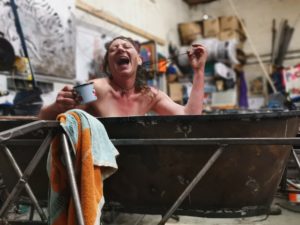
Taking a bath is a most joyful thing. And, making the time to take a bath, in these days, may even be seen as passive protest; a pause, a space to dream and a time to question what we really do value? Perhaps taking time out is the most radical thing we can do. To be sitting in a bath humming, is an act of resistance!
During lock-down and in self-isolation, many people have had time to reflect on what is truly of value to them.
I began by asking the question: Is bathing valid? But more broadly, this was a continuation of previous work which explored breathing spaces: – pauses – profound moments, activities and encounters which we experience daily, but which have no monetary value.
Living off-grid has made me more acutely aware of how dependent we are, and how caught up we are, in systems which perpetuate inequality, unsustainable production and unnecessary consumption. Our time is monetised, and bathing – (like ‘time wasting ‘ and daydreaming), is treated as non-essential, a luxury.
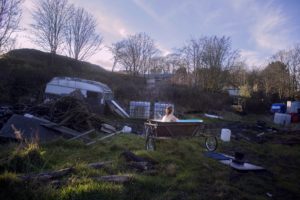
Over the last six months, I’ve been experimenting and exploring different off-grid, outdoor bathing experiences. You can read more about this here. I have lit fires under cast iron tubs in fields, tried out other peoples baths, made a steel bath tub from scratch, and invented a mobile heating system. You can see a short film, of me setting up and having one of my off-grid baths, below:
I have made an art practice from the process of taking time to bathe. You can see and hear my bath meditation performances here.
It all began when I obtained a cast iron bath with the idea of mounting it on a mobile frame which could be wheeled over a wood fire. Whilst making the initial frame, I realised that the weight of the cast iron bath would be a challenge to mobilise, and so began to collect bath tubs and to create multiple bathing installations, all of which, explored the immersive qualities of bathing in various outdoor locations. I created a bath tub from scratch out of old metal road signs welded together and I’m currently about to create another bath tub -this time a heart shaped one which I hope to tour around the UK.
There’s an exhilaration that comes with sitting in warm steamy water, in the outdoors, whilst listening to birds song, with nothing between you and the sky and the feeling of the cold air on your exposed skin.
I’ve decided that I really want others to share in this amazing experience, and I’m planning a project that will provide very special bath times to as many people as possible – especial those who don’t normally take time out for themselves like carers, workers, those suffering anxiety and stress, and people on the edges of society.
My dream is to create the Bath Bubble – a beautiful, mobile, heated, heart-shaped steel bath, which can be set up in any field, woodland or garden, for anyone to enjoy. I’m raising funding to make this happen at the moment.
If you can contribute, or share the fundraiser, I’d be very grateful. Perhaps you would like to have a go in the bath. or have a wonderful idea for a wild bath location to give to someone who would really benefit? Let me know and I’ll see if I can make it happen.
Shrine to the Liminal is a dedication to our ‘encounters’, our relationships and our connections with other species and with each other, in a time we are forever passing from.
It is an immersive space of sounds and raw light which attempts to slow people down, allowing them to just ‘be’ in the space.
The sound is created from recordings made at twilight and at dawn – liminal times of day when the natural becomes more prominent. The sounds are on differing length loops so that the experience is always changing and never repeats.
The project is on-going and aims to manifest in several iterations at outdoor events and as exhibition pieces this year.
You can see a film of the project installed in a pop-up space in Leeds here.
As part of this project people have been invited to contribute writing for the Companion Eulogies – a small publication of collated writings which accompany the shrines.
The eulogies are attempts to capture in words the moments of ‘otherness’, moments of connection, moments which reach across the ‘abyss’ and are gone forever. If you are interested in having a copy or would like to write something for the next edition please email for more information: Jessica@jessicarost.co.uk
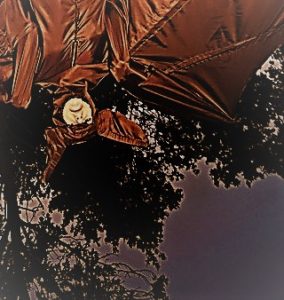
Becoming Batty is a new live performance piece created by Jessica Rost.
It will be performed on Sunday 8th March, 2pm, The Tetley, Leeds as part of Print, Perform Present.
You can watch a film of the piece being performed at Common Ground, Blackburn, here.
Developed from a poem written by the artist, Becoming Batty performance tries to define the distances we maintain between each other, between other creatures and other things. But also the illusion of separation which makes us think we are exceptional.
Batty is about an inability to empathize, or the importance of empathy and the imagination, in our becomings with others; other creatures and other things. The artist performs on stilts to a sound track of spoken word – distancing herself from the audience.
If we can imagine beyond our own singular experiences, we can realise our inter-connections, our shared biology, our shared histories, see with clear eyes and truly listen.
Batty represents all the ‘others’; the outcasts, misfits, mis-understoods, the unvoiced and the unheard ones.
The piece is available to book for events and gatherings. Please email: jessica@jessicarost.co.uk if you are interested.
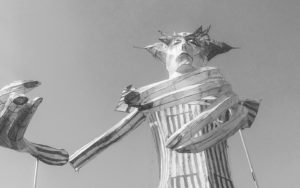
At the beginning of this year I was commissioned to create a 30ft high Mean Spirit which was to be set alight at the Annual Flamboyance -an outdoor event produced by fellow collaborator Nick Garnett of the Annual Daydream Harvest.
The ‘Meany’ was to be articulated with a turning head mechanism, operated from 20ft below, and arms that could be puppeteered as well.
Once the moving parts and welding work was done at the workshop in Milton Keynes, the frame was taken to the John Madejsky Academy in Reading where students helped to put flesh on the giant using willow and other combustible material.
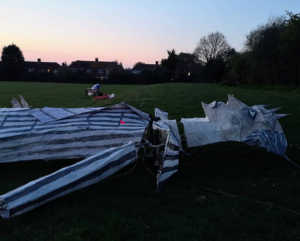
Meany awaits his fate in Rabsons rec
An amazing volunteer team from Rising Sun Arts Centre worked with me on the production; helping finish the make and loading the giant with fire rope and gerbs!!
They became the crew: pyro-technicians and puppeteers on the project and it was a real privilege to work with them.
The event itself was part of a sequence of annual events called Flamboyance. This edition was: ‘Flamboyance- turning the world upsidown’. It was completely anarchic -as is to be expected from Annual Daydream Harvest associate artistic director and long term co-collaborator Nick Garnett!
Whilst the young people were parading the streets of Whitley, in the most extraordinary contraptions and costumes – with amazing musical accompaniment from Tim Hill and others- the Meany team were preparing the finale in Rabsons rec…
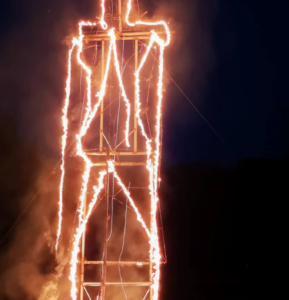
Mean Spirit alights
The music changed and the vibe became menacing… “Go home” boomed the Mean Spirit. “Stop having fun!” he boomed again with his arms flaying around. The young people threw love and happiness at him but he was still mean.”Banish him,” they began to chant, “banish him!”
Red smoke bombs were deployed, the fireworks were ignited, the fire rope was lit and the big Meany succumbed to his fate…
By the time the fire brigade arrived he was nothing more than an ashen metal frame again!!
Soon after being part of the declaration of the Extinction Rebellion (XR) in Parliament Square last October, I was commissioned by Handmade Parade, an incredible company based in Hebden Bridge, to create a giant puppet for Lamplighter Festival in Todmorden.
Their theme was circus and at the time I remember feeling very torn -It was the week of the bridges and I was ready to sit in the road with the rebels for as long as it took!
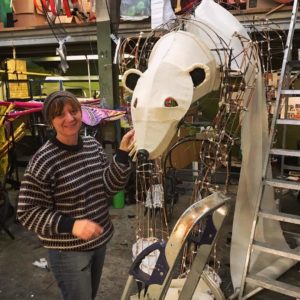
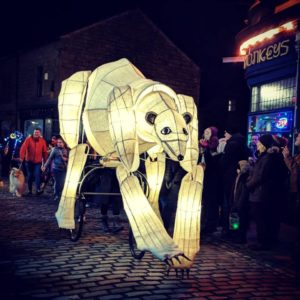
Making Eva the polar bear
There wasn’t a big budget and I wanted to do the commission, (Handmade Parade is a real pleasure to work with -they are like family) but it had to be ‘un-circus’, it had to be a polar bear and I wanted to share the puppet with the company afterwards.
(You can read more about my time making Eva in Hebden Bridge here.)
It was agreed and in my mind I knew then that Eva the bear would become part of the rebellion, it was just a matter of when and where.
After that I got very busy with other projects. It’s pretty precarious trying to earn a living as an artist at the best of times- work has to be taken as and when it comes in. Every time I went to my workshop I looked at Eva the Ice bear filling the space, so ready to rise up and roar for the cause! “Please take me out”, she seemed to be telling me.
I knew I couldn’t do it alone -logistically she needed a van and at least one other person and I didn’t have a van! I had recently lost my whole company, everything, I was starting out again as Rost Productions a completely new thing… I was also re evaluating my life, my work, everything, (as many of us are), asking myself how I can scale down, make my practice more sustainable, reduce my carbon foot print etc.
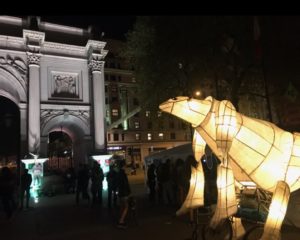
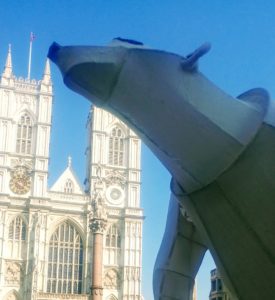
Eva the Ice bear at Marble Arch
As it happens I know first hand how frustrating and often ineffectual politics can be. I was brought up by politicians; my father was a member of Parliament from 1970-1990’s. A long standing Member of the Energy Select Committee, he was banging on about renewables, combined heat and power, global warming etc. 30 or 40 years ago! I watched his frustration and his life’s work falling on deaf ears, years wasted by a system of government that wasn’t listening to the experts -except when it suited them for political gains. It is a system that promotes the game players and not those with any integrity or those who are telling the truth. I’ve been half involved in many protests over the years myself but knowing how futile these battles are against the self interests of the system I found it difficult to take myself off the fence.
The theory and the real power of non-violent protest had never been explained to me before…how a relatively small group of people peaceably braking the law had in the past really changed things: the suffragettes braking windows, the civil rights and gay rights movements, Ghandi and others -their actions had changed things and the new cognitive culture that they helped to create had become the new norm. XR felt totally different and for the first time I thought this is actually possible!
“…where despair ends and tactics begin”!
By February this year I had begun to get more involved with my local XR affinity group in Milton Keynes and agreed to host some arty making sessions at my workshop. I was so overwhelmed by the support and the motivation of people who got involved.
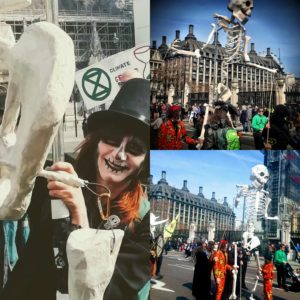
We made a massive skeleton -Shelly the Skelly -who was designed to be carried on the train and through the underground. Shelly was able to pop-up big -5m or so- anywhere we could carry her to. It was a useful challenge and a tester for the kind of future work I hope to create.
I became linked up with an XR Skelly group coordinated by the brilliant Kat and I felt like at last I was able to give something to this important cause. But it was also an amazing way to meet so many like minded people, some of whom happened to live really near me -who’d have thought! This is one of the most brilliant things that the XR movement has done -brought people together. The members of my local XR team carried the parts of Shelly down to London on the train and then we defiantly paraded her around Parliament Square.
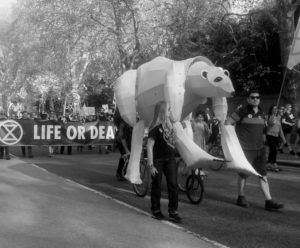
The rebellion was well underway when I left London again, bringing Shelly the Skelly back home. I only had a day turnaround before setting off to do an event in Reading for the week…and there was Eva in the workshop as usual; “If not now then when? I was made for this rebellion, please take me to London”, she whispered.
Returning from Reading after midnight on Easter Saturday from an exhausting gig, having stilt walked for 3 hours and set fire to a 30ft effigy of a Mean Spirit, I was ready for action and so was Eva the Ice bear!
Looking for ice in Hyde ParkEmma, Mischief Maker meeting Greta
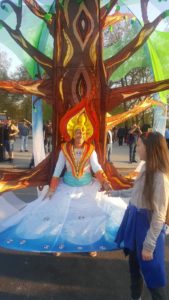
With fellow artist and amazing rebel, Emma, who’d return with me from Reading, we headed up to my workshop on Easter Sunday and loaded Eva and Emma’s giant Earth costume into a van. We didn’t really have a plan -at least not one that didn’t keep changing! So I just set the controls (sat nav.) to the heart of the sun! (Parliament Square) and we were off.
By the time we got near we had been in contact with an XR driver who was able to meet us and take the van off our hands.
Rebels met us, helped us to rig, put on costumes and with quite a bit of difficulty we managed to steer around the troublesome police officers who began to target Eva as we turned the corner towards the square…
Eva spent two amazing days rebelling in London, marching from road block to road block, from Parliament to Marble Arch. She listened to some really inspiring speakers, gained tonnes of admirers and met some incredible people. What a beautiful, hopeful vibe we rebels created -if this is the future bring it on!
Follow me on twitter @madd_eva
Eva’s looking forward to returning to the cause soon… maybe with Hugh, the cycle-powered Mammoth, who’ll be made of plastic nets? I’m in the midst of creating him now so keep all your onion bags for me please!
Polar bear puppet, created for Lamplighter Festival
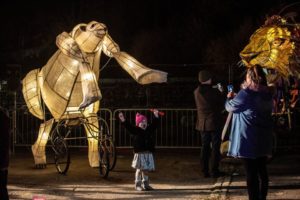
In November 2018 I spent an amazing week in North Yorkshire creating ‘Eva’ a giant polar bear puppet for Lamplighter Festival in Todmorden.
The puppet was specially commission by Handmade Parade, an incredible company based in Hebden Bridge, who produce Lamplighter Festival and many other fantastic events.
Much of the mechanics of the puppet I made back in my workshop in Milton Keynes before arriving in Hebden, including the wheel base for the bear and all her moving parts. Once on site I was able to finish welding the frame and covering her.
Handmade Parade is a fascinating company, set up by Andrew and Kathy Kim who, although still involved, have recently handed the company on and now concentrate on their amazing Visual Arts company Thingumajig Theatre.
With the highly talented Kerith Ogden, as Artistic Director, Handmade Parade successfully manages to deliver really meaningful community based work whilst not compromising on quality one tiny bit. The attention to detail and the making skills of those working for the company really inspired me. All around me there was an real buzz of activity as artists worked on giant lanterns, puppets and incredible parade items…
It was an absolute pleasure to be part of such an awesome and supportive team and I’m looking forward to working with Handmade Parade again.
‘Eva the Polar Bear’ is available for bookings in 2019. Find out more here.
Roaring Polar bear puppet, created for Lamplighter Festival
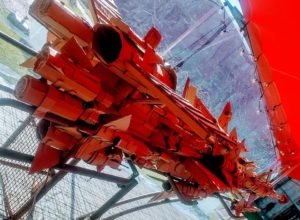
Cardboard Rocket made by 100 children at IF: Milton Keynes International Festival 2018 Vodafone UK
During the summer of 2018 I delivered some ‘high octane’ fueled creative engagement work for Vodafone UK, as they prepared to launch their Gigafast 1000 super fast broadband in various places around the UK, including in Milton Keynes.
I provided 6 days of activity, bringing in collaborators to deliver cardboard rocket building, space costumes, movement and to create an ‘out of this world’ soundscape with the young participants.
Working mainly with my colleague Nick Garnett to create the rocket, we facilitated activity for over 100 children. The spacey installation went on show at MK Central Library for one month after the festival for people to see and explore!
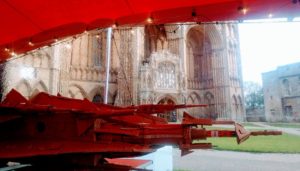
Cardboard Rocket made by 100 children at Peterborough Cathedral for Vodafone UK
Vodafone were so happy with the results and the interest that the installation created, that they asked for the rocket to be reconstructed at their HQ in Newbury, where it was on display and admired for a further month.
In October last year, I was asked to provide more ‘high octane imagination’ activity -this time in Peterborough. Nick and I spent a week there, under the shadow of the great cathedral, creating the Gigafast 1000, mark 2.
Cardboard Rocket made by 100 children at Peterborough Cathedral for Vodafone UK
It was very inspiring to be making a rocket just outside Peterborough Cathedral whist inside, Tim Peake’s landing capsule was on display!
I’m hoping that we’ll get the chance to create the Gigafast 1000, mark 3 soon… so watch this space!!
In August 1993 three recent Fine Art graduates; Claire Summerson, Emma Talbot and Jessica Rost, all from Birmingham School of Art, put on their first group exhibition at The City Discovery Centre in Milton Keynes, where one of the artists, Clare, had a studio.
Point of Contact was an exhibition of new work: paintings, sculpture and installation displayed in and around the Cruck Barn at Bradwell Abbey. Following the exhibition both Claire and Jessica became active members of The Silbury group of Artists in Milton Keynes throughout the late 90’s.
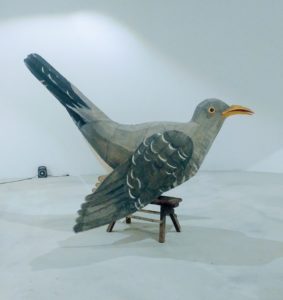
‘Cuckoo: it’s all about you’, Mechanical sculpture created for ‘2nd Point of Contact’ exhibition
Emma Talbot gained a place at the RCA. She now exhibits her work internationally and has recently been appointed Tutor in Painting at the RCA.
Clare Summerson relocated to Cornwall and is Co-founder of the Day-Light group putting on spectacular outdoor participatory and commissioned work. She is based at Krowji Redruth, where she continues to make site-specific mixed media work.
Jessica Rost remained in Milton Keynes organising international artist exchanges and residencies at Westbury Farm. She went on to found Festive Road and to set up the MK Festival Fringe. She now works nationally as a freelance producer and director of street theatre and sculpture.
2nd Point of Contact will see these three artists come together once again to exhibit in a group show at Milton Keynes Museum.
The exhibition will be open everyday from 12th until 19th July.
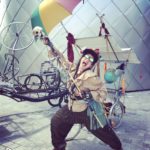
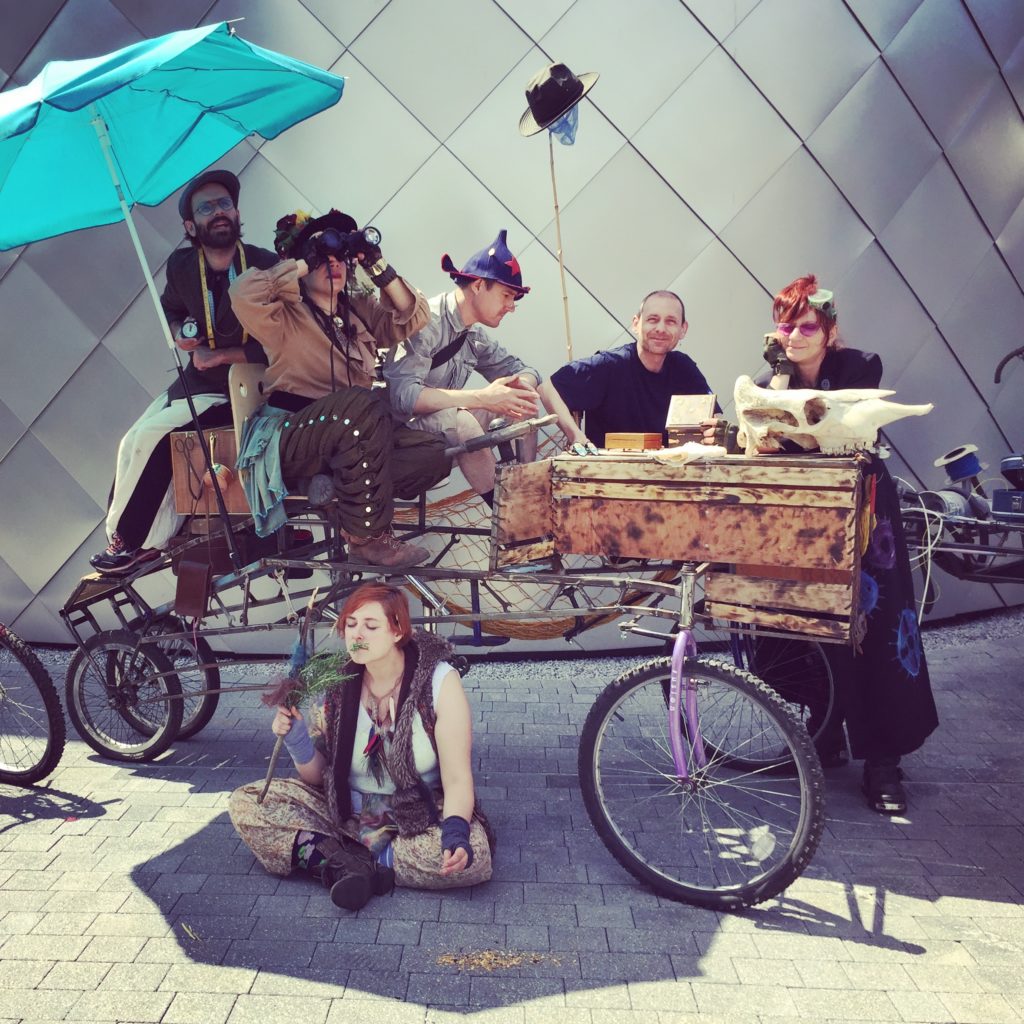
The show was presented in 2018, as part of ‘New Work Works’ for Bedlam Fair, Bath and was also performed at MK Festival Fringe,Winter Droving and LakesAlive! It involves five very individual characters, with some extraordinary offers, and incorporates specially created soundscapes by Stuart Moore. Although these peddlers are very much of present day and place, they have a definite other worldliness about them.
These five engaging hucksters will be hawking the fringes and byways this summer: conducting their commerce, and making connections, interactions and unforgettable transactions – the like of which you could not ever have imagined possible. Come and find them before they find you!
Traditionally peddlers were people who travelled about the countryside selling wares or services. They were often immigrants, outcasts or people on the margins of society. They would offer novelty items, handmade produce or mending and repair services to people who were not able to travel into villages and towns easily.
You’ll find them travelling about the byways, carrying their wares on bicycles and barrows …now seeking bookings for next year.

 I began by asking the question: Is bathing valid? But more broadly, this was a continuation of previous work which explored breathing spaces: – pauses – profound moments, activities and encounters which we experience daily, but which have no monetary value.
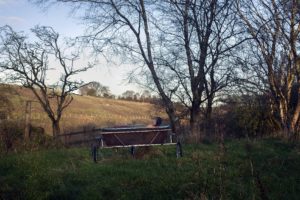 There’s an exhilaration that comes with sitting in warm steamy water, in the outdoors, whilst listening to birds song, with nothing between you and the sky and the feeling of the cold air on your exposed skin.
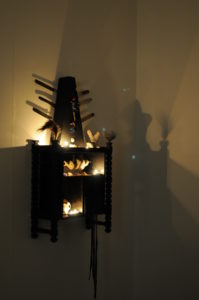 Shrine to the Liminal is a dedication to our ‘encounters’, our relationships and our connections with other species and with each other, in a time we are forever passing from.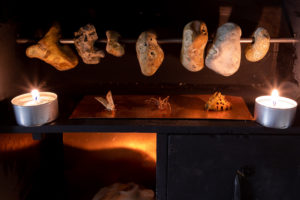
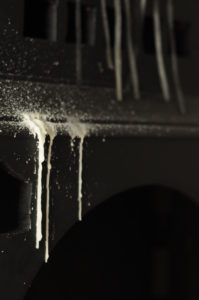
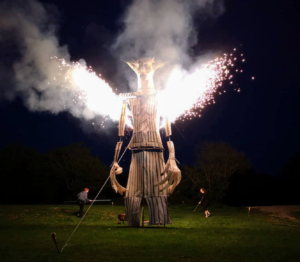
 Red smoke bombs were deployed, the fireworks were ignited, the fire rope was lit and the big Meany succumbed to his fate…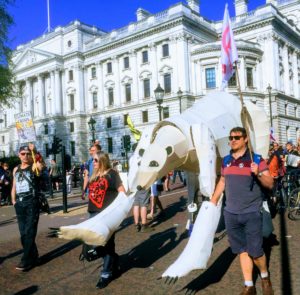
 The rebellion was well underway when I left London again, bringing Shelly the Skelly back home. I only had a day turnaround before setting off to do an event in Reading for the week…and there was Eva in the workshop as usual; “If not now then when? I was made for this rebellion, please take me to London”, she whispered.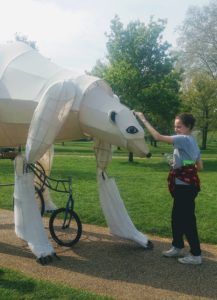

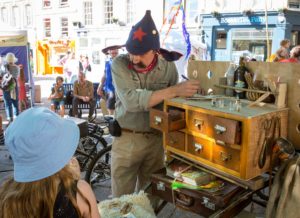 The show was presented in 2018, as part of ‘New Work Works’ for
 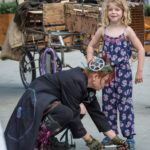 These five engaging hucksters will be hawking the fringes and byways this summer: conducting their commerce, and making connections, interactions and unforgettable transactions – the like of which you could not ever have imagined possible. Come and find them before they find you!
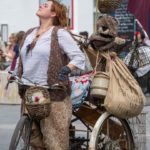 Traditionally peddlers were people who travelled about the countryside selling wares or services. They were often immigrants, outcasts or people on the margins of society. They would offer novelty items, handmade produce or mending and repair services to people who were not able to travel into villages and towns easily.